
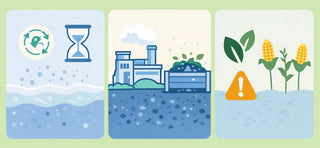
If you’ve ever stood in a store aisle wondering what the difference is between:
- Biodegradable
- Compostable
- Bio-based
You’re not alone.
These words sound similar. They are often used interchangeably in marketing. But scientifically, they mean very different things.
Understanding the difference changes how you evaluate materials, and whether a product will actually behave the way you expect at the end of its life.
Let’s clarify.

1) BIODEGRADABLE: A BROAD AND OFTEN MISUSED TERM
At its core, “biodegradable” means that a material can be broken down by microorganisms into natural substances such as water, carbon dioxide, methane, and biomass.
But here’s the critical detail:
The term does not specify how long it takes, or under what conditions.
A material may technically be biodegradable, but:
• Only in high heat
• Only in industrial composting
• Only after decades
• Or only in specific microbial environments
Without time and conditions attached, “biodegradable” can be vague.
The important question is:
Biodegradable in what environment, and over what timeline?

2) COMPOSTABLE: A DEFINED STANDARD
“Compostable” is more specific.
A compostable material must break down within a defined time frame under composting conditions, leaving no toxic residue and supporting plant growth.
In the United States, industrial compostable products are often tested under ASTM standards.
Industrial composting facilities typically maintain:
• High temperatures (around 55–60°C / 130–140°F)
• Controlled moisture
• Active microbial communities
• Regular turning and aeration
Home composting is very different.
Many products labeled “compostable” require industrial conditions and will not break down quickly in backyard compost piles.
So the next question becomes:
Industrial compostable?
Or home compostable?

3) BIO-BASED: ABOUT ORIGIN, NOT END-OF-LIFE
Bio-based refers to where a material comes from.
It means the product is derived partially or fully from renewable biological sources such as plants.
Examples include:
• Corn-based plastics
• Sugarcane-derived polymers
• Plant fibers
But bio-based does not automatically mean biodegradable.
A material can be:
- Bio-based and not biodegradable
- Biodegradable and not bio-based
- Compostable but only industrially
Origin and end-of-life are separate questions.
4) WHY THESE DISTINCTIONS MATTER
When materials are confused, expectations are misaligned.
A family may assume:
“It’s biodegradable, so it will disappear in the yard.”
But if it requires industrial composting temperatures, that may not happen.
Clarity prevents disappointment.
Clarity prevents greenwashing.
Clarity helps families make decisions aligned with real-world disposal systems.
5) A SIMPLE DECISION FRAMEWORK
When evaluating a material, ask:
-
What is it made from?
-
Is it biodegradable?
-
Under what conditions?
-
Over what time frame?
-
What is the most likely end-of-life in my community?
If your local infrastructure does not support industrial composting, an industrial-only compostable product may function similarly to conventional plastic in landfill.
System alignment matters.
6) WHERE ECO DESIGN FITS
The goal is not to chase labels.
The goal is to design materials that:
• Align with realistic disposal systems
• Minimize fragmentation risk
• Avoid microplastic creation
• Reduce long-term persistence
Better material design means thinking about:
Origin
Use phase
End-of-life
Infrastructure compatibility
All at once.
A CALM CONCLUSION
Not all sustainable claims are equal.
“Biodegradable” is broad.
“Compostable” is condition-specific.
“Bio-based” refers to origin.
Understanding these differences helps families make decisions based on science, not marketing language.
Progress does not come from perfection.
It comes from informed choices.