
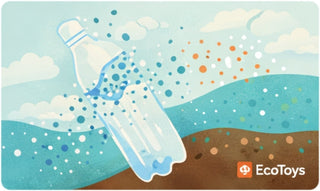
If there is one idea that changes how you see plastic pollution, it is this:
Most plastic does not biodegrade in any meaningful way.
It fragments.
It becomes smaller and smaller pieces, spreads across more places, and becomes harder to remove.
That is why the real question is not only:
“Do we recycle?”
It is also:
How much plastic are we producing?
Where does it go?
And what happens when it breaks into pieces too small to see?
Let’s walk through the science.
1) THE U.S. PLASTIC REALITY: MOST OF IT IS NOT RECYCLED
According to U.S. Environmental Protection Agency materials data, plastic recycling rates in the United States remain low compared to how much plastic is generated each year.
National estimates show:
-
~76% is landfilled
-
~15–16% is incinerated for energy recovery
-
~8–9% is recycled

That means the majority of plastic produced in the U.S. does not re-enter a circular system.
For decades, the public narrative has been:
“Plastic is fine if we recycle it.”
But when recovery systems only capture a small fraction, plastic is not primarily a recycling issue.
It is a flow problem.
A high-volume material designed for convenience is moving through disposal systems that cannot reliably recover it.
A practical takeaway:
If a product is designed to be used briefly, and the recovery system is weak, the most likely outcome is disposal, not circularity.
2) “BREAKING DOWN” IS NOT THE SAME AS BIODEGRADING
Language matters.
-
Degradation can mean cracking, fading, and fragmenting into smaller pieces.
-
Biodegradation means microorganisms convert a material into basic natural outputs such as water, CO₂, methane, and biomass under specific conditions.
Many conventional plastics degrade physically.
Few biodegrade meaningfully in real-world environments.
Especially in:
-
Oceans
-
Cold water
-
Low oxygen conditions
-
Landfills
So when you hear:
“It breaks down.”
The real question is:
Breaks down into what?
And on what timeline?
3) HOW LONG DOES PLASTIC ACTUALLY LAST?
One of the most misunderstood aspects of plastic is time.
Here are widely cited environmental estimates:
- Plastic bag: ~10–20 years (fragments into microplastics)
- Plastic straw: ~200 years
- Plastic bottle: ~450 years
These are not biodegradation timelines.
They are fragmentation timelines.
Most conventional plastics do not fully return to natural components. They break into smaller particles that persist in soil, waterways, and oceans.
Time does not make plastic disappear.
It makes it smaller.
4) MICROPLASTICS: SMALLER THAN 5 MILLIMETERS
Microplastics are commonly defined as plastic particles smaller than 5 millimeters.
They can be:
-
Primary microplastics — intentionally manufactured small particles
-
Secondary microplastics — fragments created when larger plastic items break apart
Why this matters:
-
Smaller particles travel easily through air, water, and soil.
-
They are extremely difficult to collect once dispersed.
-
They persist in ecosystems for long periods.
Recent scientific research has identified microplastics in:
-
Oceans
-
Freshwater systems
-
Agricultural soils
-
Human blood
-
Lung tissue
-
Placental tissue
The research field is still evolving, but one thing is clear:
Fragmentation does not equal disappearance.
A simple mental model:
Large plastic = waste management problem
Microplastic = environmental systems problem
Those are very different challenges.
5) WHY RECYCLING IS STRUCTURALLY LIMITED
Even when families sort correctly, recycling plastic remains difficult at scale.
Here’s why.
A) Plastic Is Not One Material
Different polymer types cannot always be mixed. When incompatible plastics are combined, the output quality drops.
B) Contamination Is Common
Food residue, adhesives, labels, and mixed materials make processing expensive and often uneconomical.
C) Virgin Plastic Is Often Cheap
When new plastic is inexpensive to produce, recycled plastic struggles to compete economically.
D) Downcycling Is Common
Even when plastic is recycled, it is often converted into lower-grade materials that cannot be recycled again.
That is not circularity.
It is a slower route to landfill or combustion.
6) WHAT THIS MEANS FOR FAMILIES
This is where we believe in clarity, not guilt.
A science-based approach is not about perfection.
It is about leverage.
Small, high-impact decisions compound over time.
High-Leverage Swaps
-
Choose durable products that are actually kept and reused.
-
Avoid products likely to be lost outdoors.
-
Reduce mixed-material items when possible.
-
Look for clear disposal instructions.
The guiding question becomes:
“What is the most likely end-of-life outcome for this item?”
If the honest answer is landfill, combustion, or environmental loss, choosing a better material or longer-lasting option aligns with reality.
Not symbolism. Reality.
7) CONCLUSION
- Plastic does not disappear.
- It fragments.
- Microplastics are measurable, definable particles.
- Once dispersed, they are extremely difficult to recover.
- But progress does not require panic.
- It requires informed decisions.
- Better systems.
- Better materials.
- Better product design.
And families who understand how the system actually works.
WANT TO CONTRIBUTE?
We are building a library of real-world stories.
- What you bought.
- How it held up.
- What worked.
- What did not.
Submit your story. We read every single one, and we may feature yours in the Eco Play Journal or Eco Play Bulletin.